Library Data And Doing Interesting Things With It
Oct 22, 2009 by devcsi-team
We would like to bring to your attention the very high quality competition winners and completed demonstrators for the JISC Mosiac Project.Anyone who is interested in developing applications that use data from libraries would get some real inspiration by looking at these examples which were based on four years of data from the University of Huddersfield library, namely circulation library records and information relating to courses.The applications created covered three areas; Improving Resource Discovery, Supporting Learning Choices and Supporting Decision Making. Five of the entries were received from the UK and one from the USA. All are proof of concept or demonstration prototypes.First PrizeAlex Parker a Computer Science undergraduate from the university of Southampton won the first prize of £1000 with ‘Book Galaxy‘. This allows users to browse and / or key word search for books and courses using a constellation type visual interface rather than a list of books. This tool requires the installation of JAVA and was tested on Firefox 3.0.14 and in Internet Explorer 7.
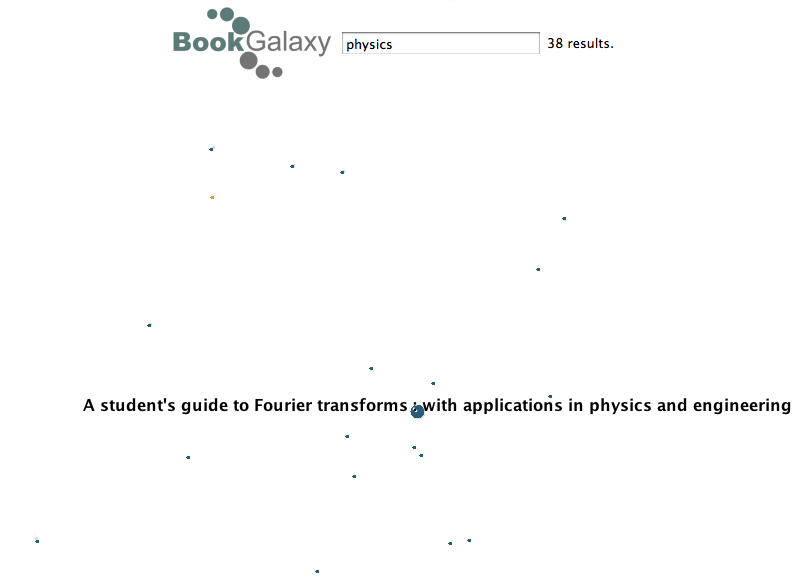
Book Galaxy
Screen shot of Book Galaxy
: The search term ‘physics’ was used and it produced a dynamic ‘constellation’ or ‘galaxy’ of points which when hovering over provides information about books that have been found for this topic.Second PlaceSecond place went to
Andrew Isherwood from the University of Aberystwyth. The application returns library lending data and the monetary value of those loans related to a specific course. It has been tested on Firefox 3.0.14 and in Internet Explorer 7.

Andrew Isherwood Aberystwyth University Entry for MOSIAC Project (Second)
Screen shot of second place in the Mosiac competition (Andrew Isherwood).
Third PlaceThird place went to
Alistair Young from the University of the Highlands and Islands, called ‘
iLib, the Course Book Finder’. This tool utilises various searches (through a keyword search) to find relevant books relating to specific courses. It has been tested on Firefox 3.0.14 and in Intnernet Explorer 7.

iLib Course Book Finder
Screen shot of the Third prize to ‘i-lib course book finder’ by
Alistair Young.
Honourable mentionsTony Hirst – Open UniversityThis
demonstrator shows how library book loan information could be used to help potential new students get an idea and feel for a prospective course by looking at the reading materials that existing students are taking out for it. It works by a user dragging a ‘bookmarklet’ to their toolbar and when they are on a page that refers to a particular UCAS code of interest, they press the button to reveal suggested reading list items. It has been tested on Firefox 3.0.14.

Tony Hirst Mosiac Entry
Screen shot of Tony Hirst’s UCAS code course reading materials tool.
Owen Stephens of the Open UniversityThis prototype is called ‘
Read to Learn’ and is a tool that makes suggestions of courses that you could study based on an uploaded list of ISBNs (for example it could comprise of the books that you have read). The tool has been tested on Firefox 3.0.14 and in Internet Explorer 7.

Read to Learn 1
Ready to Learn:
Screen Shot one (before upload of file containing lists of ISBNs).
Read to Learn 2
Ready to Learn:
Screen Shot two (after upload of file containing lists of ISBNs).Collection Development DashboardSean Hannan of Johns Hopkins University submitted the
idea of a prototype web application that visualises (though a series of bar graphs) circulation data relating to courses of study and publishers across the past 4 years. This has been tested on Firefox 3.0.14 and in Internet Explorer 7. The application requires
Adobe Flash Player 10 or above . Note – to go back up to the top of the data series you use either ‘ctrl + click’ (PC) or ‘cmd + click’ (Apple)

Collection Development Dashboard 1
Collection Development Dashboard:
Screen shot 1 – Data by year
Collection Development Dashboard 2
Collection Development Dashboard:
Screen shot 2- 2008 selected and Subjects Displayed
Collection Development Dashboard 3
Collection Development Dashboard:
Screen shot 3- BSc Psychology selected and results displayed.The MOSAIC team will be seeking feedback from Higher Education library and learning practitioners on all six applications at the series of workshops over the next month at the Universities of Edinburgh, Sheffield, Sussex and the Open University.The applications will also be featured at the concluding MOSAIC event at the University of Wolverhampton on Wednesday 18 November for more information please visit this
page.

 Citation Data Hack: Event Report
 Event Report: Managing Research Data Hack Day





0 Comments
Trackbacks/Pingbacks